Darbhanga: A Detailed Historical Account of the Heart of Mithilanchal
Introduction
Darbhanga is a prominent municipal corporation town of North Bihar and the present headquarters of both Darbhanga district and Darbhanga division. Ranked as the fifth-largest city of Bihar, Darbhanga holds immense administrative, cultural, and historical importance. Popularly known as the “Heart of Mithilanchal”, the city has long been a centre of Maithili culture, Sanskrit learning, and political influence.
Its historical journey spans ancient Mithila civilisation, medieval Islamic administration, colonial restructuring under British rule, and post-independence administrative evolution—making Darbhanga one of the most historically layered cities of eastern India.
Ancient and Cultural Background: Darbhanga in Mithila
Darbhanga lies at the core of the ancient region of Mithila, also historically known as Tirhut or Tirabhukti. Mithila is among the oldest cultural regions of the Indian subcontinent and is closely associated with Vedic scholarship, classical philosophy, and the Maithili language.
For centuries, this region produced renowned scholars of Sanskrit, Nyaya philosophy, Smriti literature, and grammar. Darbhanga emerged as a natural centre of learning and patronage due to its fertile land, river systems, and later royal support.
Origin of the Name “Darbhanga”
The origin of the name Darbhanga remains a subject of scholarly debate:
- One tradition holds that the town was founded by a local chieftain named Darbhangi Khan, from whom the city derived its name.
- Another view traces the name to the Sanskrit phrase “Dwar-Banga”, meaning the gateway to Bengal.
- A Persian derivation, “Dare-Bang”, also meaning door of Bengal, supports Darbhanga’s historical position as a transitional zone between Mithila and Bengal.
All interpretations underline Darbhanga’s strategic and cultural significance.

Darbhanga Raj and the Rise of the Maharajas
Darbhanga rose to exceptional prominence as the seat of the Darbhanga Raj, one of the largest and most influential zamindari estates in British India.
The foundation of the Darbhanga Raj is credited to Mahesh Thakur, a distinguished Sanskrit scholar. The estate was formally conferred upon him by Akbar, the Mughal emperor, who was deeply impressed by the intellectual brilliance of Raghunandan Jha, Mahesh Thakur’s disciple.
From its inception, the Darbhanga Raj was unique:
- It was governed by scholar-administrators rather than military elites.
- Sanskrit and Maithili learning received royal patronage.
- Temples, libraries, and educational institutions flourished under royal support.
Royal Architecture and the Raj Estate
Darbhanga town developed around the expansive Raj Estate, a carefully planned complex featuring palaces, gardens, temples, offices, and water bodies. Successive Maharajas constructed several architectural landmarks, including:
- Nargauna Palace
- Rambagh Palace
- Anandbagh Bhawan
- Bela Palace
These structures blended traditional Indian aesthetics with colonial architectural elements and symbolised royal authority as well as cultural refinement.
The Raj area remains one of the most distinctive urban landscapes in Bihar, reflecting centuries of planned development.
British Rule and Administrative Evolution
Under British administration, Darbhanga formed part of Sarkar Tirhut until 1875. That year marked a turning point when Darbhanga was constituted as a separate district.
Creation of Subdivisions
- Darbhanga Sadar – 1845
- Madhubani – 1866
- Samastipur (then Tajpur) – 1867
Initially, Darbhanga district was part of the Patna Division. In 1908, the British created Tirhut Division, headquartered at Muzaffarpur, placing Darbhanga within this new administrative framework.
Post-Independence Reorganisation
Major administrative changes occurred after Indian independence:
- 1972: Madhubani and Samastipur subdivisions were upgraded into independent districts.
- Darbhanga district was reduced to two subdivisions: Darbhanga Sadar and Benipur, comprising 12 development blocks.
- 1992: Creation of Biraul subdivision.
- Later, six additional development blocks were established:
- Hanuman Nagar
- Tardih
- Gaura Bauram
- Kiratpur
- Kusheshwar Asthan East
- Alinagar
These reforms reshaped Darbhanga into its present administrative form.
Geographical Setting
Darbhanga district is geographically well-positioned in North Bihar:
- North: Madhubani district
- South: Samastipur district
- East: Saharsa district
- West: Muzaffarpur and Sitamarhi districts
This central location has historically facilitated trade, administration, and cultural exchange.
Laheriasarai and Modern Administration
Laheriasarai, now an integral part of Darbhanga town, serves as the seat of district and divisional administration. Over time, it merged seamlessly with Darbhanga city, forming a unified urban entity with administrative, educational, and commercial functions.
Darbhanga as a Centre of Higher Learning
Darbhanga occupies a unique place in India’s educational landscape. It is perhaps the only city in India with two major universities sharing a contiguous campus:
- Lalit Narayan Mithila University
- Kameshwar Singh Darbhanga Sanskrit University
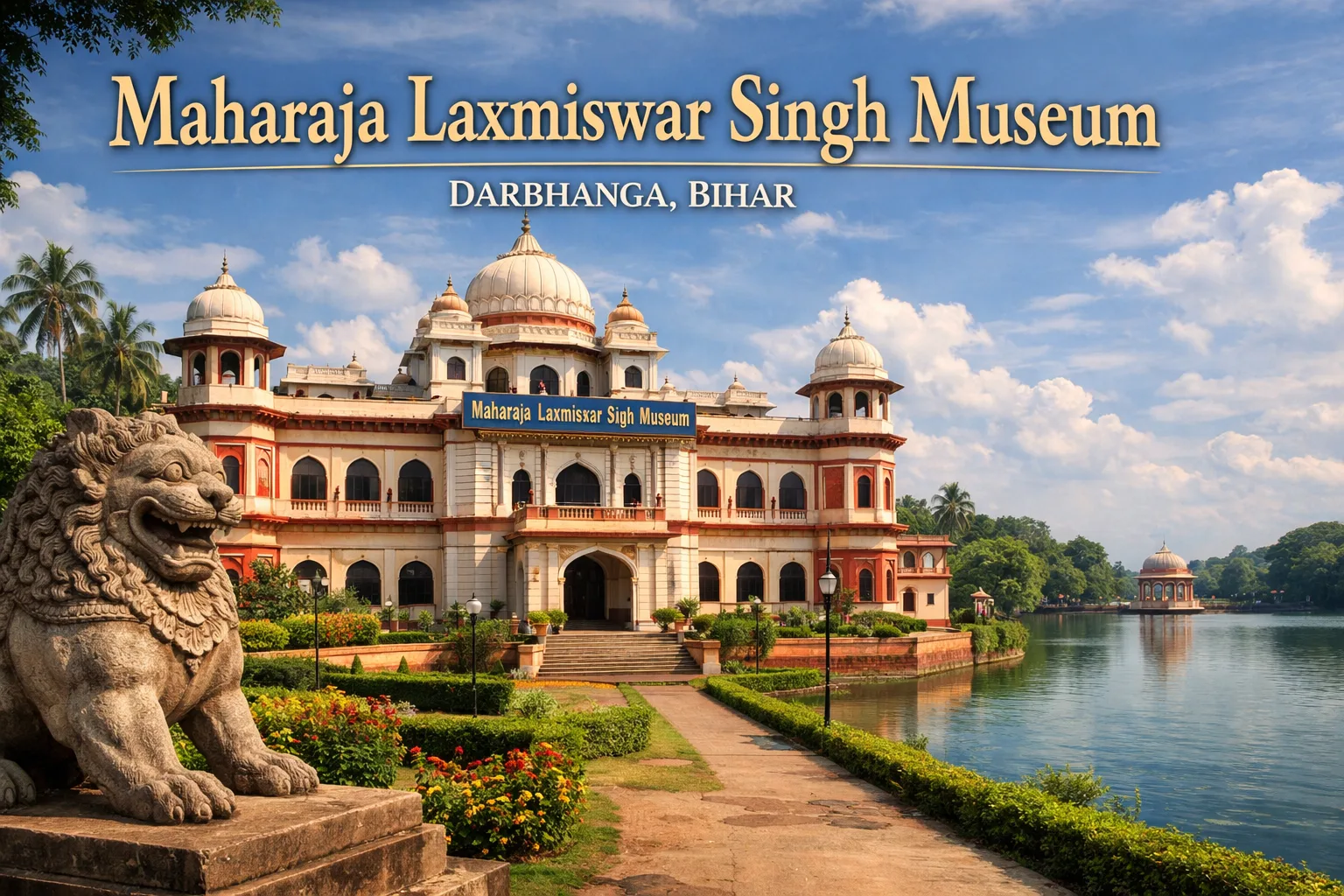
Several former palace buildings of the Darbhanga Raj now house university departments. The historic Raj Library, once maintained by the Maharajas, has been absorbed into the university system, preserving rare manuscripts and scholarly works.
Patronage of Art, Literature, and Language
The Maharajas of Darbhanga were among the greatest patrons of:
- Maithili literature
- Sanskrit scholarship
- Music, rituals, and temple traditions
Their sustained patronage ensured the survival and growth of Maithili as a literary language and preserved ancient Sanskrit learning at a time when such traditions were declining elsewhere.
Final Thought
Darbhanga’s history is not merely a sequence of administrative changes—it is the story of a city that shaped and preserved the intellectual soul of Mithila. From Mughal-era scholarly patronage to British administrative reforms and modern educational excellence, Darbhanga stands as a rare example of continuity between tradition and modernity.
Rooted deeply in culture yet adaptive to change, Darbhanga remains a living archive of Mithila’s past and a vital centre of Bihar’s present.
| Image | Product | Features | Price |
|
Our Pick
1
 |
laptop under 35000 |
Product Features |
Discover more from Mithila Delights
Subscribe to get the latest posts sent to your email.