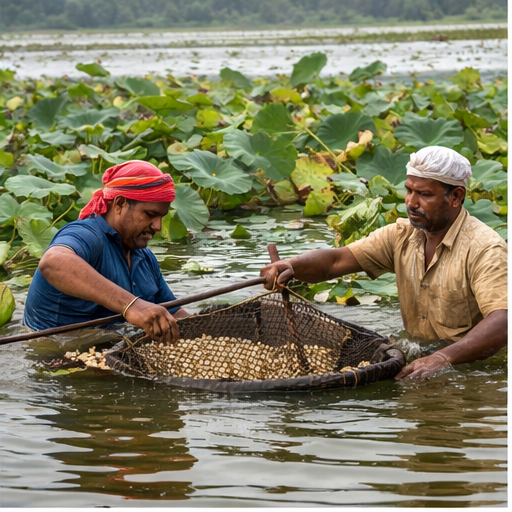
Makhana: The Lotus Pearls of the Fields — A Farmer’s Tale
In the quiet ponds and shallow waters of Mithilanchal, where the lotus unfurls its morning sun petals and dragonflies choreograph their aerial dances, another humble treasure grows beneath the surface: makhana — the fox nut, or phool makhana, the seed of Euryale ferox. To the outside world it may be a light snack, but to a farmer it’s a livelihood, a legacy, and a lesson in resilience.

The Origin Story: From Muddy Ponds to Golden Fields
Makhana isn’t planted in fields like rice or wheat. It grows in natural and manmade ponds, often in Bihar’s Mithila plains — Darbhanga, Madhubani, Purnia — where water, soil, and climate conspire just right. It thrives in slow, still water where the seeds sink, germinate, and send up leaves like tiny green balloons.
From the Farmer’s Lens:
- Timing matters in the Makhana farming. Seeds are sown with the first promise of winter (October–November).
- Water management is art. Too deep, and the shoots can’t reach sunlight. Too shallow, and drought stress chokes them.
- Weeds are rivals. Hand weeding in water is backbreaking but vital.
For farmers, this isn’t merely agriculture — it’s aquatic horticulture.

Tending the Crop: Patience in Every Plunge
Makhana’s nurture phase spans months. Throughout winter and early spring, farmers wade chest-deep into water, adjusting levels, checking growth, removing weeds, and protecting tender shoots from birds and fish.
This is labour that demands care, patience, and bodily grit. There are no tractors floating in water; there are only human hands, bamboo poles, and eyes that read the pond’s whispers.
Challenges in the Water:
- Unpredictable water levels due to untimely rain or dry spells
- Aquatic pests and snails
- No full mechanization — most work is manual
To outsiders it looks serene. To farmers it’s a daily negotiation with nature.
Harvesting: The Dance of Hands and Nets
By late spring (April–June), the seeds mature. Harvesting makhana is a spectacle of collective effort:
- Nets are spread like fishing for stars.
- Mature seeds are shaken from plants into nets.
- Then they’re dried under the sun until they shine like moonlit pearls.
This stage often becomes community work, with families and neighbours helping each other — the laughter, sweat, and chatter weaving into the fabric of rural life.
Processing: Fire, Skill, and Transformation
Raw makhana seeds are hard as river rocks. To turn them into the light, crunchy pearls you snack on, farmers or processors:
- Roast the seeds over low flame
- Press them gently so they puff up
- Sort and grade by size and quality
This process is artisanal. It requires precision, experience, and timing — too much heat and they burn; too little and they don’t puff.
From the farmer’s workshop:
- Processing increases market value significantly
- It’s often done by cottage-level units or women’s self-help groups
- Quality determines price — uniform, white, fully puffed pearls fetch higher rates
Markets and Money: Winds of Uncertainty
For the Makhana farming community, makhana’s journey to market is both promise and peril:
The Good
- Rising demand nationally and globally (health food, snacks, gluten-free diets) has boosted prices.
- Makhana is often more profitable than many cereals.
The Not-So-Good
- Price volatility: Without stable minimum support prices (MSP), farmers sometimes feel at the mercy of traders.
- Middlemen margins: A farmer’s share can shrink if supply chains are unorganized.
- Storage woes: Improper storage invites moisture, pests, and quality loss.
In essence, while makhana can be cash in hand, it also carries financial uncertainty.

Women at the Heart of Makhana Economy
The women play an important role in the Makhana farming. In many villages, it is women who lead processing, sorting, grading, and packing. Their skilled fingers decide which kernels get premium tags and which go to bulk markets.
This has:
- Empowered women economically
- Strengthened household incomes
- Cultivated cottage industries
For many families, makhana isn’t just income — it’s shared enterprise and pride.
Lessons from the Pond
For the makhana farmer, every crop cycle teaches something profound:
- Nature doesn’t hurry, yet it rewards patience.
- Water is wealth, but unpredictable.
- Hard work must be paired with fair markets.
Their bond with water and seed mirrors a kind of poetry — tender, patient, and resilient.
Makhana Beyond a Snack
Today, when you pop a crunchy makhana into your mouth, remember it’s more than a snack. It’s sunshine dried on ponds, hands that wrestled weeds, futures built one pearl at a time.
From the farmer’s point of view, makhana is:
- A crop born in water
- A labour of love and endurance
- A hope for better income
- A thread in the fabric of rural community life
In every nut lies a story — of seed, sweat, community, and the quiet joy of harvest.

Final Thought
Makhana farming is not just a means of livelihood, it is a legacy of patience, skill, and harmony with water and land.
Through floods, seasons, and uncertainty, Makhana farming teaches farmers that resilience can bloom even in muddy ponds.
Every pearl harvested proves that Makhana farming transforms hard labor into dignity, self-reliance, and hope for future generations. When supported with fair prices and recognition, Makhana farming can become a powerful engine of rural prosperity and pride.

Whether you enjoy it roasted with spices or as a light evening snack, Makhana (Fox Nuts) is one of Mithila’s most loved traditional foods. Explore a handpicked variety of premium-quality makhana online.➡️ Browse the Collection on Amazon
Discover more from Mithila Delights
Subscribe to get the latest posts sent to your email.