C.M. College, Darbhanga: A Complete Guide for Students (History, Courses, Campus, Facilities & Student Life)
If you are looking for a college in Darbhanga that combines heritage, quality education, and strong student culture, then C.M. College Darbhanga deserves your attention.
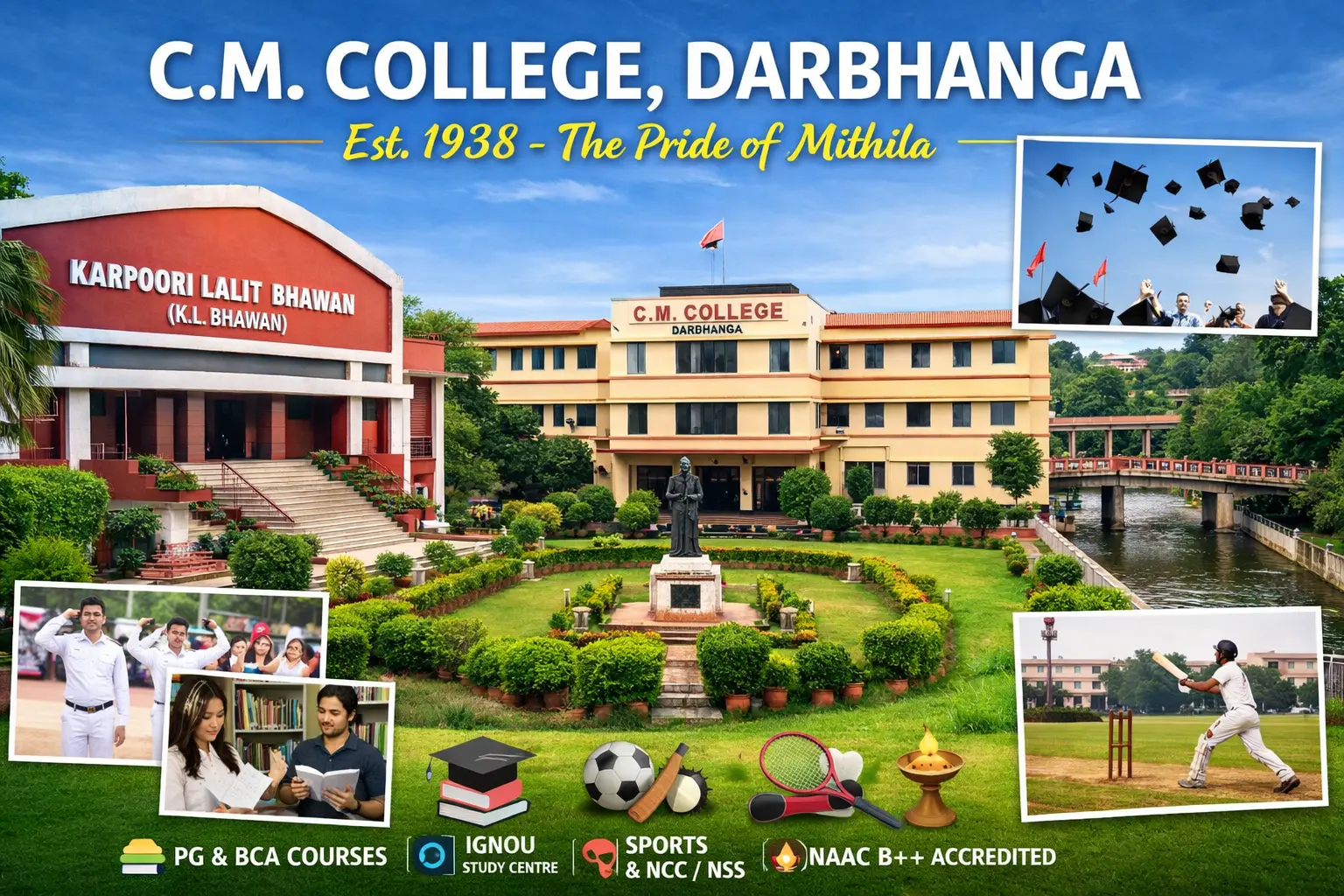
Officially known as Chandradhari Mithila Mahavidyalaya, C.M. College is widely regarded as the Pride of Mithila and one of the oldest and most respected centres of higher learning in Bihar and India. With a legacy that stretches back to the pre-independence era, this institution has continued to shape generations of students through its academic strength, campus resources, and commitment to holistic development.
This article gives you a complete and detailed overview of the college—its history, academic structure, facilities, student opportunities, and why it remains a preferred destination for higher education in North Bihar.
1) Introduction: What is C.M. College, Darbhanga?
C.M. College Darbhanga is a prestigious college that offers education in Arts and Commerce, from intermediate level to post-graduation in many subjects. Over the decades, it has become one of the most prominent institutions in the Mithila region, serving students from Darbhanga as well as neighbouring districts such as Madhubani, Samastipur, Sitamarhi, and beyond.
The college is a constituent unit of Lalit Narayan Mithila University (LNMU), Darbhanga, which means it operates under the university framework and follows its academic regulations.
2) A Proud Legacy: The History of C.M. College
Established in 1938: A Dream of Higher Education in Mithila
C.M. College Darbhanga was established in 1938, during a time when access to modern higher education in North Bihar was limited. The institution was founded under the guidance of a Citizen’s Committee, made up of respected and distinguished people of Darbhanga who strongly believed that the region needed a college that could provide:
- Higher education on a Western academic model, and
- An Oriental cultural flavour, reflecting the intellectual traditions of Mithila.
This combination of modern learning and traditional depth became a defining identity of the college.
From Mithila College to C.M. College
The college was originally named Mithila College. It began its journey in a private building at Laheriasarai, and later shifted to Oval Market, Darbhanga, near the Tower area.
A major figure in turning this dream into reality was Pandit Gangadhar Mishra, a senior advocate from Saurath (Madhubani). His tireless dedication played a historic role in building the institution, and in honour of his pioneering efforts, the campus is known as:
- Gangadhar Niketan
Why is it called “C.M. College”?
The college received its present name C.M. College due to the generosity and support of Late Chandradhari Babu of Ranti Deorhi (Madhubani). His contribution helped the institution grow stronger despite early challenges such as:
- shortage of space
- financial constraints
- limited infrastructure in the early years
Key Supporters Who Strengthened the College
The college gained stability and a “real lease of life” through the efforts of:
- Dr. S. K. Sinha (the first Chief Minister of Bihar)
- Late Kunwar Kalyan Lal (a distinguished citizen of Darbhanga)
- Late Surendra Prasad Sinha (then Vice-Chairman of Darbhanga Municipality)
Thanks to long-term cooperation between the Municipality and Government, the college expanded smoothly and continued to develop without legal complications.
Growth of Degree Education (Early 1950s)
By the early 1950s, the college began providing degree education in four faculties:
- Arts
- Science
- Commerce
- Law
(Later, the Science section became a separate college, which we will discuss below.)
Affiliation Changes (1952 onwards)
In 1952, the college moved away from the older Patna University framework and became affiliated with the newly formed Bihar University.
The first permanent Principal, Dr. B. M. K. Sinha (Professor of English), later became the first Registrar of Bihar University, Muzaffarpur—a remarkable achievement that reflects the academic stature of the institution.
A New Era of Excellence: Postgraduate Teaching (1962)
The college reached new heights under Principal Dr. L. K. Mishra, who had earlier served the college in the 1940s as a lecturer in Chemistry.
Under his leadership:
- the college became a major centre of academic excellence
- in 1962, Postgraduate teaching began in selected subjects in Arts and Commerce
In the same period, the college became a constituent unit of Bihar University, Muzaffarpur, with retrospective effect (ratified on 30 March 1962). The document was signed by Pt. Radha Nandan Jha, the then Secretary of the college.
Foundation of the Present Campus (1965)
In April 1965, Bihar’s then Chief Minister Pt. Binodanand Jha laid the foundation stone of a large new building on land known as Paliram Garden, where the present campus stands today.
Birth of Mithila University & Academic Expansion (1972)
On 5 August 1972, the college became the nucleus of postgraduate teaching in:
- Arts
- Science
- Commerce
This was a historic moment for Mithila because it aligned with the creation of Mithila University at Darbhanga, fulfilling a long-standing public demand for a strong university in the region.
The Split into Two Colleges (1974)
In 1974, the composite institution was divided into:
- C.M. College (Arts + Commerce)
- C.M. Science College
This split helped both institutions focus better on their respective academic streams.
3) Campus Layout: A Unique Campus Divided by the Bagmati River
One of the most unique and memorable features of C.M. College is that its campus is divided into two parts by the River Bagmati.
Eastern Part (Main Academic Zone)
The eastern side includes:
- Main college building
- Academic departments
- Separate common rooms for boys and girls
- NCC and NSS offices/cells
- College Library
- BCA Centre
- IGNOU office
- Principal’s chamber
- Administrative block
- PNB Bank branch
- Post office
- Swimming pool
Western Part (Residential & Sports Zone)
The western side includes:
- College hostel
- Principal’s residence
- Teachers’ quarters
- Sports ground
- Women’s hostel (under construction with UGC grant)
Both parts are connected through a bridge on the northern side, allowing students to move between academic and residential/sports areas.
4) Academic Programmes: What Can You Study at C.M. College?
C.M. College offers education from Intermediate level to Post-Graduation, mainly in Arts and Commerce.
It also supports professional and vocational learning to help students develop career-ready skills.
Key Academic Highlights
- Teaching in most subjects of Arts and Commerce
- Dedicated staff room for every department
- Regular academic support activities
BCA (Bachelor of Computer Applications)
The college introduced the BCA course with updated regulations from the academic session 2015–16, offering students an opportunity to build careers in:
- IT
- Software and computing
- Digital services
- Government and private sector tech roles
5) Vocational Courses: Skill-Based Education for Careers
To strengthen employability and modern learning, the college provides vocational education (sponsored by the University) in six vocational courses, including:
- Creative Writing and Translation
- Library and Information Science
- Journalism
- E-Commerce
- Foreign Trade
- Hospitality and Catering Management
These courses are extremely valuable for students who want practical skills alongside academic degrees.
6) Library & Learning Resources
A Library with Over One Lakh Books
The college library is a major academic asset, with:
📚 More than 1,00,000 books
📖 A spacious and well-furnished reading room
This is especially helpful for students preparing for:
- University examinations
- Competitive exams
- Academic research
- Literature and reference-based study
INFLIBNET Membership
The college has also become a member of INFLIBNET, which strengthens access to academic resources and digital learning support.
7) Auditorium & Examination Hall: The Iconic K.L. Bhawan
A prized possession of the college is its grand auditorium-cum-examination hall with a seating capacity of:
- 2,500 persons
It is named Karpoori Lalit Bhawan (K.L. Bhawan) in memory of two distinguished alumni:
- Late Karpoori Thakur
- Lalit Narayan Mishra
This hall is used for major academic and institutional activities, including examinations and events.
8) NAAC Accreditation and Academic Recognition
C.M. College Darbhanga is now well into its long journey of excellence and has completed over eight decades since its inception.
A major achievement is its accreditation:
🏅 NAAC Grade: B++ (2017)
This accreditation reflects quality benchmarks in academics, institutional functioning, and student support systems.
9) Student Support: Remedial Coaching & Inclusive Education
The college runs a UGC Sponsored Remedial Coaching Programme for:
- SC/ST students
- Economically weaker students
This initiative helps learners strengthen their academic foundation, improve performance, and compete confidently.
10) IGNOU Study Centre: Education for Distance Learners
C.M. College hosts an active IGNOU Centre, functioning fully since 1997.
Current strength:
👨🎓👩🎓 Around 1,500 students
This centre supports students who need:
- flexible education
- distance learning programmes
- opportunities to study while working
11) NCC, NSS & Student Development
C.M. College strongly focuses on the all-round development of students. Along with academics, students are motivated to participate in:
- NCC (National Cadet Corps)
- NSS (National Service Scheme)
- sports and extracurricular activities
Such engagement builds:
- discipline
- leadership
- teamwork
- public service values
- confidence and communication
12) Sports Culture: A Strong Focus on Athletics and Games
The college provides excellent infrastructure and facilities for multiple sports, including:
- Lawn Tennis
- Basketball
- Football
- Volleyball
- Cricket
- Judo
- Kabaddi
- Athletics
- Table-Tennis
Students have participated in:
- Inter-University meets
- Intra-University meets
- various competitive tournaments
Sports Quota Preference
Preference in admission is given to candidates belonging to the above-listed games. The College Sports Committee supervises and manages sports-related activities.
Even students who are not admitted through sports quota are encouraged, and adequate facilities are made available to all aspiring sportspersons.
Why Choose C.M. College Darbhanga?
Here are the strongest reasons why students prefer this college:
- Legacy since 1938 and respected academic history
- Constituent unit under LNMU, Darbhanga
- Strong Arts & Commerce education with PG teaching
- Skill-based vocational programmes for career growth
- BCA course for modern tech education
- Massive library and strong learning environment
- NAAC B++ accreditation (2017)
- NCC/NSS and excellent sports facilities
- IGNOU centre for flexible learning
- Campus facilities including bank, post office, hostels and more
#FollowUs

Explore B.Com Books & Study Material
If you’re preparing for B.Com exams or want to strengthen your concepts, you can explore a wide variety of B.Com books, guides, and study materials online.
Discover more from Mithila Delights
Subscribe to get the latest posts sent to your email.