Khaja Traditional Bihari Sweet: The Crisp, Layered Sweet That Carries Bihar’s Culinary Memory
By Mithila Delights Desk
In the wide landscape of Indian sweets, some desserts shout their presence with colour and richness. Others speak quietly, through technique, texture, and time. Khaja, a traditional Bihari sweet, belongs firmly to the second category. Crisp, layered, lightly soaked in sugar syrup, and deceptively simple, Khaja has travelled across centuries, rituals, and regions, holding its place in Bihar’s food culture with remarkable steadiness.
For a portal like Mithila Delights, which documents the cultural and everyday life of the Mithila region, Khaja is not just a sweet item. It is a living record of local craftsmanship, seasonal habits, and social exchange.

What Is Khaja?
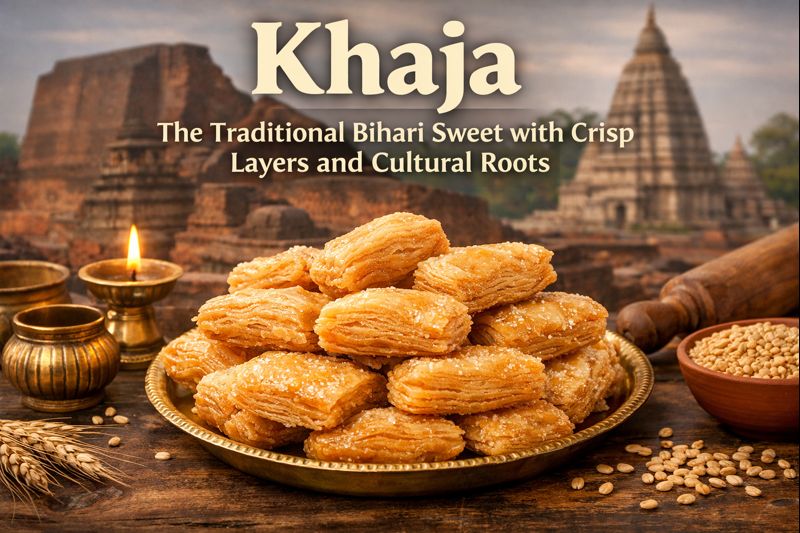
Khaja is a dry-to-the-bite yet syrup-kissed, the traditional Bihari sweet made primarily from wheat flour, ghee, and sugar. The dough is rolled into thin layers, folded carefully, deep-fried slowly, and then dipped briefly in warm sugar syrup. Once cooled, the syrup crystallises on the surface, giving Khaja its characteristic crackle.
Unlike many Indian sweets that depend on milk or khoya, Khaja belongs to a grain-based tradition. This makes it more durable, travel-friendly, and suitable for storage—qualities that helped it spread across Bihar long before modern packaging existed.
A Sweet With Regional Roots
Although Khaja is known across Bihar, its strongest association today lies with Silao, a small town near Nalanda. Silao’s Khaja has received Geographical Indication (GI) status, recognising its distinct method and long-standing reputation.
In the Mithila region, Khaja appears in weddings, religious offerings, and long journeys. It is not always the centrepiece, but it is almost always present. Its neutrality—neither too rich nor too festive—allows it to fit many occasions.
Historical Mentions and Culinary Continuity
References to Khaja-like preparations appear in medieval texts and temple traditions across eastern India. Food historians often point out similarities between Bihar’s Khaja and layered sweets found in Odisha and parts of Nepal, suggesting shared culinary routes rather than a single origin.
In Mithila, oral tradition links Khaja to pilgrim routes and scholarly travel. The sweet’s long shelf life made it ideal for scholars, traders, and devotees who travelled between learning centres such as Nalanda, Tirhut, and Janakpur. Over time, it became part of household sweet-making rather than remaining a specialty item.
Ingredients and Technique: Where Skill Matters
The ingredient list of Khaja is short. The process is not.
-
Wheat flour (maida)
-
Pure ghee
-
Sugar
-
Water
The key lies in lamination—the repeated folding and rolling of dough with ghee to create thin internal layers. This technique demands experience. Too much pressure collapses the layers. Too little makes the sweet uneven.
Frying temperature is equally critical. Khaja must cook slowly, allowing layers to separate without browning too fast. The final sugar dip is brief. Over-soaking turns it soggy. Under-soaking leaves it bland.
In traditional kitchens, these steps are judged by sight, sound, and smell rather than timers.
Khaja in Social and Ritual Life
In Mithila and central Bihar, Khaja frequently appears in:
-
Weddings: packed with other dry sweets for distribution
-
Religious offerings: especially during Satyanarayan Katha and local pujas
-
Travel gifts: carried for relatives in distant towns
-
Seasonal markets: especially in winter, when frying is easier
Unlike sweets tied to a specific festival, Khaja remains season-neutral. This flexibility has helped it survive shifts in food habits.
Silao Khaja and GI Recognition
Silao’s Khaja stands apart for its uniform layers, pale colour, and balanced sweetness. Local producers follow inherited methods, often working in small family units.
The GI tag has helped protect the name “Silao Khaja” from misuse. However, it has also brought new challenges. Rising demand risks pushing artisans towards shortcuts. Traditional makers continue to stress that Khaja cannot be rushed.
Khaja vs Other Layered Indian Sweets
Khaja is often compared with:
-
Balushahi: richer, softer, milk-fat based
-
Soan Papdi: fibrous and airy
-
Pua: batter-based and perishable
Khaja’s identity lies in its restraint. It is crisp but not brittle. Sweet but not heavy. It reflects an older food philosophy where balance mattered more than indulgence.
Changing Markets, Enduring Taste
Urbanisation and packaged sweets have reduced home preparation of Khaja traditional Bihari sweet. Yet demand remains steady, especially during wedding seasons and pilgrimages. Online orders from Silao now reach cities across India.
For cultural platforms like Mithila Delights, documenting such foods is part of recording everyday history. Khaja does not belong to royal kitchens alone. It belongs to lanes, halwais, and travel trunks.
Why Khaja Still Matters
Khaja traditional Bihari sweet survives because it serves a purpose. It travels well. It shares easily. It does not overpower the palate. In a food culture increasingly driven by novelty, Khaja stands for continuity.
As long as Bihar values its everyday traditions, Khaja will remain more than a sweet. It will remain a marker of place.
#FollowUs
Khaja traditional Bihari sweet.
Discover more from Mithila Delights
Subscribe to get the latest posts sent to your email.