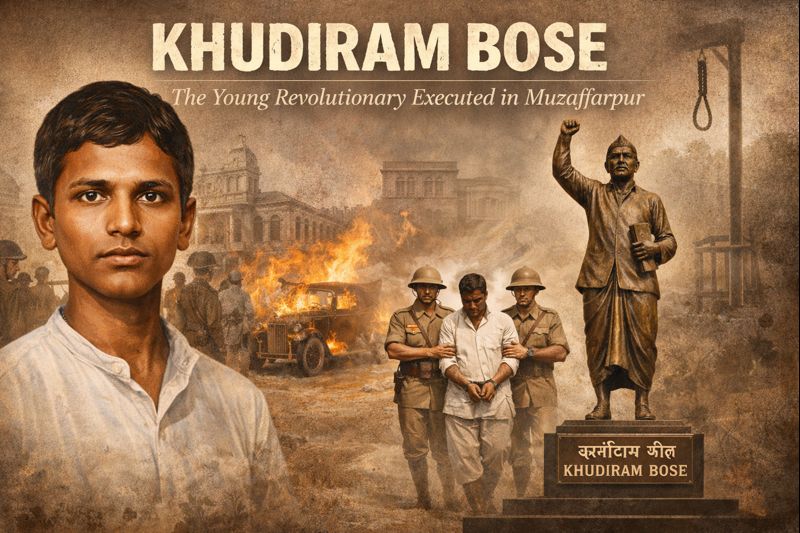
Khudiram Bose: The Young Revolutionary Whose Sacrifice Echoed from Muzaffarpur to the Nation
India’s freedom struggle was not shaped only by negotiations, resolutions, and mass movements. It was also forged through the courage of very young revolutionaries who chose the path of direct action, fully aware of its consequences. Among them, Khudiram Bose occupies a singular place in history. Though born in Bengal, his final chapter unfolded in Muzaffarpur, Bihar, firmly linking his legacy with the region and making him an enduring figure in Bihar’s freedom movement.
This article traces the life, struggle, and death of Khudiram Bose, placing his story in the historical landscape of early twentieth-century India and highlighting why Muzaffarpur remains central to his remembrance.

Early Life and Influences
Khudiram Bose was born on 3 December 1889 in the Midnapore district of Bengal Presidency. Orphaned at an early age, he was raised by his elder sister. His childhood coincided with a period of intense political ferment in Bengal, marked by resistance to colonial policies and the growing influence of revolutionary nationalism.
As a schoolboy, Khudiram was drawn to nationalist activities. The Swadeshi Movement, launched in response to the Partition of Bengal in 1905, deeply influenced him. Public meetings, patriotic songs, and pamphlets created an atmosphere where political resistance was no longer confined to elites. For young Khudiram, nationalism became not an abstract idea but a moral duty.
He soon came into contact with revolutionary groups that believed armed resistance was necessary to confront British repression. These groups operated in secrecy, relying on discipline, ideological commitment, and youth participation.

Entry into Revolutionary Politics
Khudiram Bose joined revolutionary networks linked to Anushilan Samiti, which aimed to overthrow British rule through targeted actions against colonial officials. Unlike mass movements that sought gradual pressure, these groups believed that dramatic acts could inspire wider resistance.
Despite his age, Khudiram proved fearless and committed. He was involved in distributing pamphlets, participating in protests, and learning the use of explosives. His youth allowed him to move with less suspicion, but it also exposed him to extreme risk.
By 1907, British authorities had intensified surveillance of revolutionary groups, particularly after a series of assassination attempts on colonial officials in Bengal.
The Muzaffarpur Mission
The defining moment of Khudiram Bose’s life came in 1908, when he was tasked with assassinating Douglas Kingsford, a British magistrate known for his harsh treatment of Indian nationalists. Kingsford had been transferred from Calcutta to Muzaffarpur, in present-day Bihar, following earlier threats to his life.
Khudiram, along with fellow revolutionary Prafulla Chaki, travelled to Muzaffarpur to carry out the plan. On the night of 30 April 1908, they threw a bomb at a carriage they believed was carrying Kingsford. The attack, however, tragically killed two British women instead.
The incident sent shockwaves through Muzaffarpur and the wider colonial administration. British authorities launched an immediate crackdown.
Arrest and Trial in Muzaffarpur
After the bombing, Khudiram Bose was arrested while attempting to escape. Exhausted and injured, he was caught by villagers and handed over to the police. Prafulla Chaki evaded arrest initially but later took his own life to avoid capture.
Khudiram’s trial was conducted in Muzaffarpur, making the town a focal point of revolutionary history. Despite his young age—he was only 18—the colonial government treated him as an adult revolutionary.
During the trial, Khudiram reportedly remained calm and composed. His demeanour, especially his smile while being led to court, deeply impressed the public and press. Newspapers across India carried accounts of the young revolutionary facing death with courage.
Execution and Death
On 11 August 1908, Khudiram Bose was executed by hanging in Muzaffarpur Central Jail. He became one of the youngest martyrs of India’s freedom struggle.
His execution triggered widespread protests and mourning. In Bengal and Bihar alike, people observed strikes, sang patriotic songs, and commemorated his sacrifice. The image of a teenage revolutionary going to the gallows unflinchingly became a powerful symbol of resistance.
Muzaffarpur, where he was tried and executed, thus entered the national memory as the place where colonial justice confronted youthful defiance.
Impact on the Freedom Movement
Khudiram Bose’s death marked a turning point in India’s revolutionary movement. It exposed the moral intensity of youth participation and forced national leaders to acknowledge the depth of popular anger against colonial rule.
While Mahatma Gandhi later advocated non-violence as the primary path to freedom, even he recognised the emotional force behind revolutionary actions. Khudiram’s sacrifice added urgency to the national debate on how independence should be pursued.
For Bihar, his story reinforced the region’s role as more than a passive participant in the freedom struggle. Muzaffarpur became associated not only with administrative control but also with revolutionary resistance.
Memory, Memorials, and Regional Legacy
Over the decades, Khudiram Bose has been remembered through statues, memorials, and institutions named after him across India. In Muzaffarpur, his association with the town remains central to local historical consciousness.
His life is taught in schools, referenced in literature, and remembered on martyrdom days. Yet, beyond textbook summaries, his connection to Bihar deserves deeper public attention.
Platforms like Mithila Delights play a role in documenting such intersections of national history and regional experience. Khudiram Bose’s story is not just a Bengali narrative; it is also a chapter of Bihar’s political past.
Why Khudiram Bose Still Matters
Khudiram Bose matters because he represents the extreme edge of youthful idealism. He was not driven by personal gain or recognition but by a belief that freedom demanded sacrifice.
His story also reminds us that India’s independence was achieved through multiple paths—constitutional politics, mass movements, and revolutionary actions. Understanding these layers provides a more honest account of the freedom struggle.
For readers today, especially younger generations, Khudiram Bose’s life raises difficult questions about courage, responsibility, and the cost of political change.
Final Thought
Khudiram Bose lived only 18 years, yet his impact far outlived his short life. From his early awakening in Bengal to his execution in Muzaffarpur, his journey reflects the intensity of India’s struggle against colonial rule.
As India continues to revisit its past, remembering figures like Khudiram Bose ensures that the freedom movement is seen not as a single story but as a collective effort shaped by regions, individuals, and moments of extraordinary courage.
#Freedom Fighters From Muzaffarpur
#FollowUs
Discover more from Mithila Delights
Subscribe to get the latest posts sent to your email.