Kolhua: Where Stone Remembers History
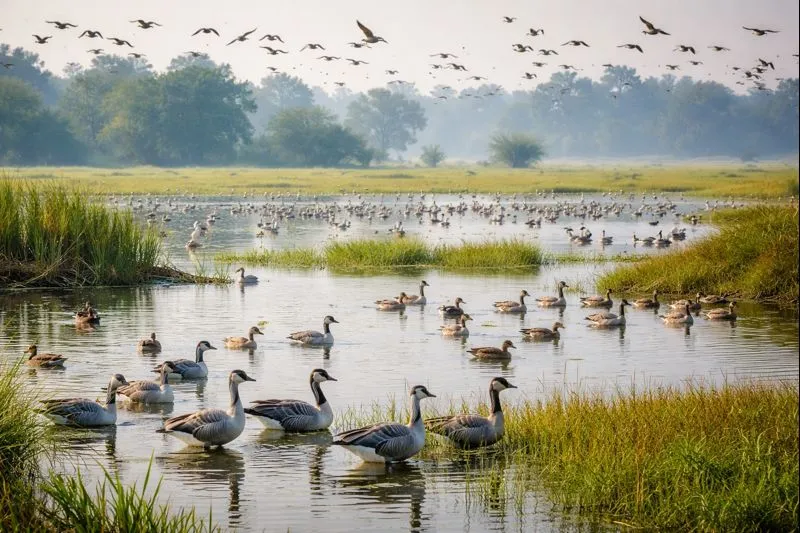
At first glance, Kolhua looks like a quiet patch of countryside—fields stretching into the distance, birds tracing slow circles in the sky, and a calm that feels older than time itself. But the moment you step closer, you realise this silence is not empty. It is full of memory.
Kolhua lies in the Muzaffarpur district, about 65 kilometres north-west of Patna. Long before highways and railway lines, this land witnessed one of the most remarkable chapters of human civilisation.

A Lion That Has Watched Centuries Pass
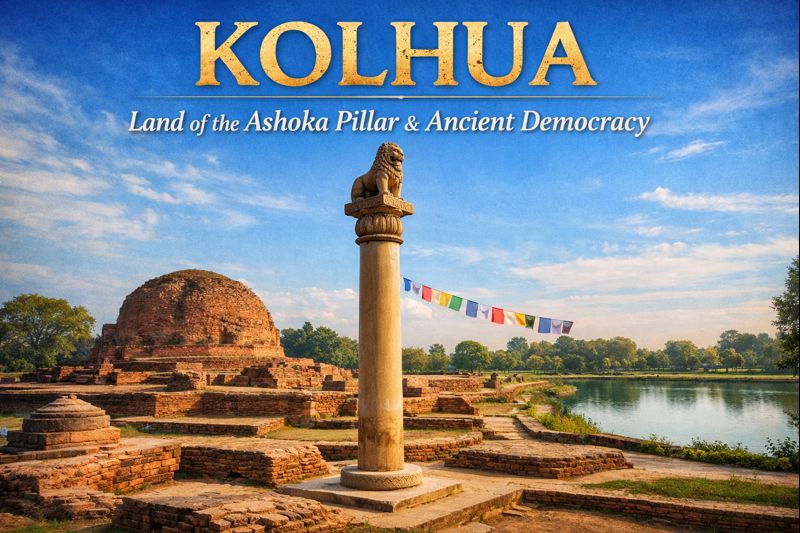
Standing tall at Kolhua is the famous Ashokan Pillar—smooth, monolithic, and carved from polished sandstone. It was erected by Ashoka, the Mauryan emperor known to history as Ashoka the Great.
The pillar rises with quiet dignity. Its circular shaft leads up to a graceful bell-shaped capital, crowned by a life-size lion facing north. The lion does not roar. It does not threaten. It simply stands—calm, alert, and timeless—like a guardian of truth and order.
Many visitors say that when sunlight touches the polished stone, the pillar seems to glow softly, as if history itself is breathing.
Land of the World’s First Democracy
Kolhua is part of the ancient land of Vaishali, once the capital of the Vajji Confederacy. Historians regard this region as the home of the world’s earliest known republic—a place where collective decision-making shaped governance centuries before modern democracies were imagined.
As you walk through Kolhua, it is impossible not to feel that sense of participation and public life still lingering in the air. This was not just land ruled by kings; it was land guided by assemblies, debates, and shared responsibility.
Echoes Scattered Across the Soil
Kolhua does not hold its history in one monument alone. It spreads its past gently across the surrounding landscape.
A short walk takes you to Raja Bisal ka Gadh, believed to be part of ancient Vaishali. Nearby lies the Relic Stupa, a quiet mound that speaks of devotion and remembrance. Then there is Kharouna Pokhar, also known as Abhishek Pushkarini, where sacred rituals are believed to have taken place.
Places like Chakramdas and Lalpura may appear modest today, but together they form a map of an age when philosophy, faith, and governance grew side by side.
A Journey That Feels Personal
Discover Kolhua in Muzaffarpur—home to Ashoka’s Pillar, ancient Vaishali, and the roots of the world’s first democracy. A timeless heritage site.
What makes Kolhua truly special is not just its archaeological value, but the feeling it leaves behind. There are no crowds rushing you along, no loud signs demanding attention. Instead, Kolhua invites you to slow down, to listen, and to imagine.
Children play near ancient stones. Farmers work the same soil that once felt the footsteps of monks, rulers, and citizens of a young democracy. Past and present live here without argument.
How to Reach Kolhua
- By Air: The nearest airport is Patna, approximately 65 kilometres from Kolhua.
- By Train: Kolhua is about 30 kilometres from Muzaffarpur Railway Station.
- By Road: Well connected by road from Muzaffarpur, Hajipur, and Chhapra (Saran).
Why Kolhua Matters Today
In an age of fast news and fleeting attention, Kolhua reminds us that ideas can outlive empires. Democracy, justice, moral governance—these were not modern inventions here. They were lived realities.
To visit Kolhua is not just to see a pillar. It is to stand in a place where humanity once experimented with something extraordinary—and left its mark in stone.
#FollowUs
Discover more from Mithila Delights
Subscribe to get the latest posts sent to your email.