Muzaffarpur: Beyond Litchis, a City with History and Heart
When people hear the name Muzaffarpur, the first thing that comes to mind is often its world-famous litchis. Sweet, juicy, and fragrant, Muzaffarpur litchis have carried the city’s name far beyond Bihar and even beyond India. But to reduce Muzaffarpur only to its fruit would be unfair. This is a city shaped by history, faith, trade, migration, and everyday resilience.
Situated in north Bihar, Muzaffarpur has long functioned as a bridge—between Mithila and Tirhut, between rural life and urban aspiration, and between tradition and change. To truly understand Muzaffarpur, one must look past its orchards and into its streets, temples, railway lines, and people.
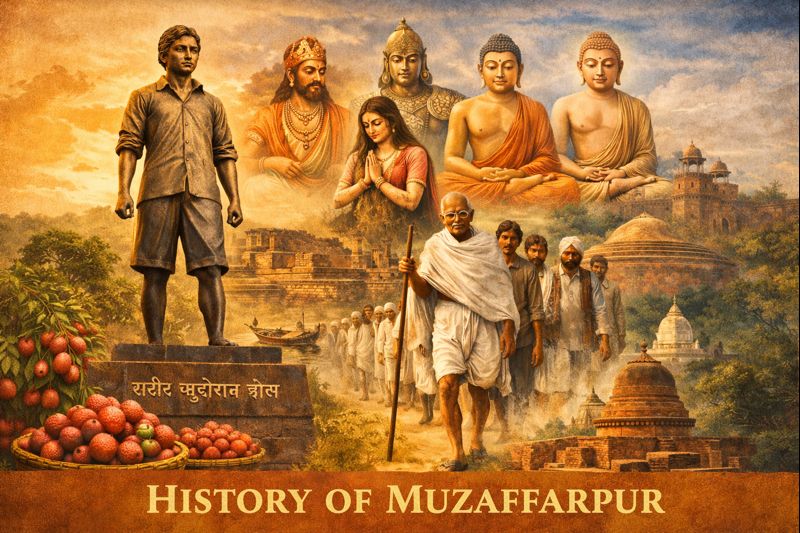
A Brief History of Muzaffarpur

The history of Muzaffarpur is layered, much like Bihar itself. The region was once part of the ancient Tirhut area, which played an important role in early Indian history. Archaeological and literary sources suggest that this region was inhabited and cultivated well before the medieval period.
The modern name “Muzaffarpur” is believed to have emerged during Mughal times, possibly linked to Muzaffar Khan, a local administrator. Over centuries, the area passed through Mughal, regional, and later British control, each phase leaving its imprint on administration, trade, and social structure.
Under British rule, Muzaffarpur gained importance as a district headquarters. Roads, courts, and railways were established, turning it into an administrative and commercial hub. The city also became part of India’s freedom movement, producing lawyers, teachers, and activists who participated in nationalist politics.
Muzaffarpur and Mahatma Gandhi’s Legacy
Muzaffarpur holds a quiet but significant place in India’s national history due to its association with Mahatma Gandhi. In 1917, when Gandhi first arrived in Bihar to investigate the plight of indigo farmers in Champaran, Muzaffarpur was one of his early stops.
It was here that Gandhi stayed, interacted with local residents, and prepared for what would later become the historic Champaran Satyagraha. This moment marked the beginning of mass-based nonviolent resistance in India. For Muzaffarpur, this association remains a point of historical pride rather than tourist spectacle.
Cultural Life: Simple, Rooted, and Lived Daily
Muzaffarpur’s culture is not confined to festivals or monuments—it lives in everyday routines. The city sits at a cultural crossroads, influenced by Mithila traditions as well as Bhojpuri-speaking regions nearby.
Language and Expression
Hindi is the dominant language of public life, but Bajjika, Maithili and Bhojpuri are widely spoken in homes and neighborhoods. This multilingual environment shapes the city’s literature, folk songs, humor, and oral storytelling traditions.
Local poetry, folk theatre, and devotional music continue to thrive, often performed during religious gatherings or community events rather than formal stages.
Religious Spaces and Shared Faith
Religion plays a visible but calm role in Muzaffarpur’s social fabric. Temples, mosques, and shrines exist side by side, reflecting long-standing coexistence.
One of the most visited landmarks is Garib Sthan Mandir, a major Shiva temple that attracts devotees throughout the year. The temple is especially crowded during Shravan month, when pilgrims arrive from nearby towns and villages.
These religious spaces also function as social centers—places where people meet, talk, and participate in collective life beyond ritual.
Muzaffarpur Litchis: Pride of the Region

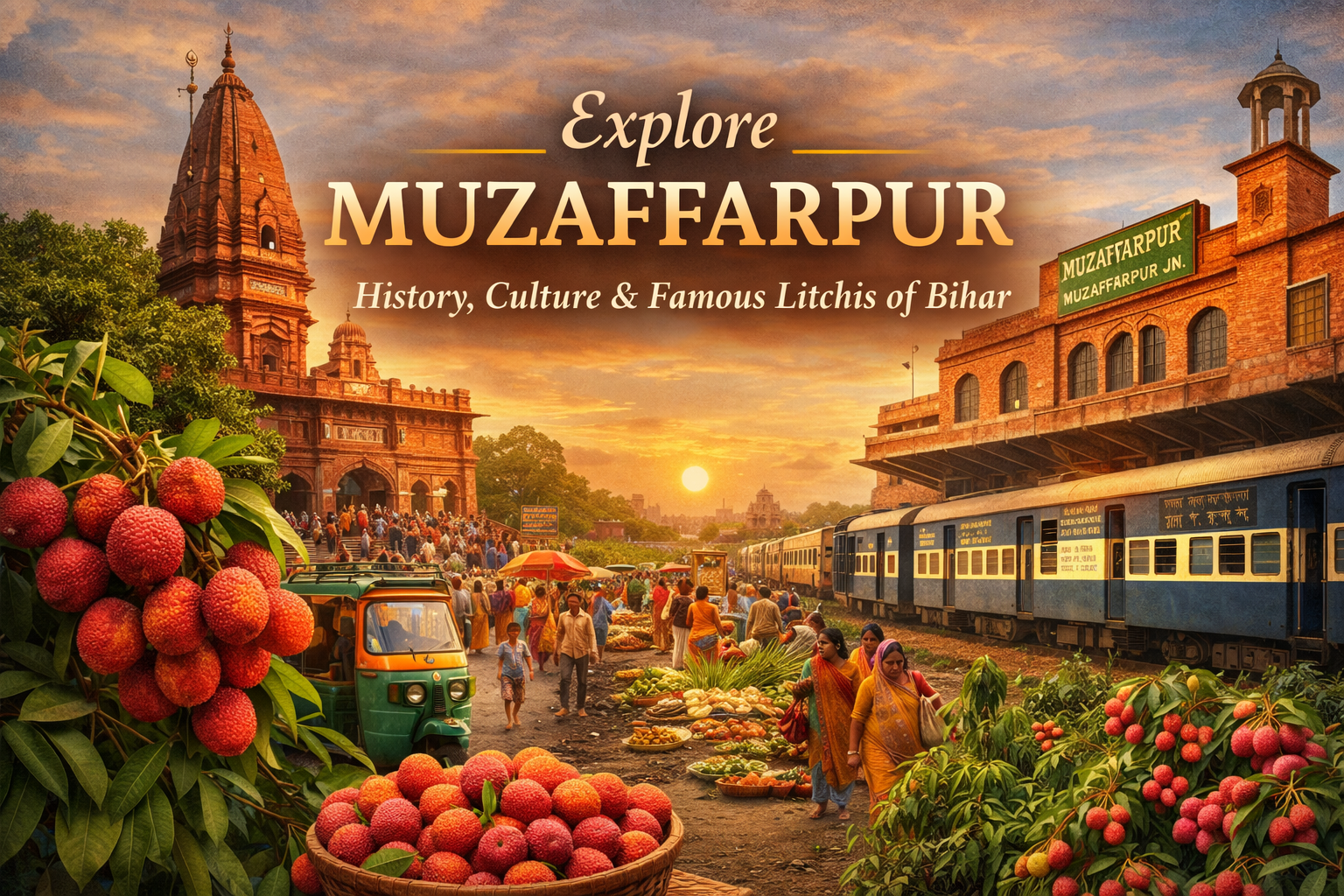
No discussion about the city is complete without its most famous export: Muzaffarpur litchis. Particularly known for the Shahi Litchi, this fruit has earned Geographical Indication (GI) status, placing Muzaffarpur on the global agricultural map.
Litchi cultivation here is not just an economic activity—it is a cultural rhythm. Summers in Muzaffarpur are marked by harvesting, packing, bargaining, and sending crates of fruit across India. Entire families participate in the process, and local markets come alive with the scent of fresh produce.
For many farmers, litchi orchards are inherited livelihoods, passed down through generations, tying land, labor, and identity together.
Markets, Food, and Everyday Life

Muzaffarpur’s markets reflect its dual nature—traditional and modern. Areas like Motijheel and Saraiyaganj bustle with street vendors, small shops, and roadside eateries.
The local food culture is simple and comforting. Common meals include rice, dal, seasonal vegetables, and mustard-based preparations. Street food such as litti-chokha, samosas, and sweets like peda and jalebi are popular across social classes.
Tea stalls serve as informal meeting spaces where politics, cricket, prices, and personal stories are exchanged daily.
Education and Modern Growth
Over the years, Muzaffarpur has emerged as an important educational center in north Bihar. Colleges, coaching institutes, and professional training centers attract students from nearby districts.
Institutions affiliated with Babasaheb Bhimrao Ambedkar Bihar University play a key role in higher education. While challenges remain, education continues to be a major aspiration for the city’s youth.
Modern developments such as improved road connectivity, digital services, and healthcare facilities are gradually reshaping Muzaffarpur’s urban landscape.
Muzaffarpur Tourism: Quiet but Meaningful
Muzaffarpur is not a conventional tourist city, and perhaps that is its strength. Visitors do not come here for grand monuments or luxury resorts. They come to understand a living city—its pace, people, and everyday realities.
For travelers interested in cultural history, agricultural heritage, and authentic local life, Muzaffarpur offers an experience free from spectacle. It invites observation rather than consumption.
A City That Moves Forward Without Forgetting
Muzaffarpur today stands at an important moment. It is growing, modernizing, and adapting, yet it remains deeply tied to its roots. The litchi orchards still bloom. Old neighborhoods still hold memories. Faith, family, and education continue to shape aspirations.
This balance—between continuity and change—is what defines Muzaffarpur.
It may not always demand attention, but for those who take the time to know it, Muzaffarpur leaves a lasting impression: honest, grounded, and quietly significant.
Discover more from Mithila Delights
Subscribe to get the latest posts sent to your email.